This week's theme: the AI industry's fault lines showed, and several run straight through your classroom. The race leader lost its lead as ChatGPT fell below half the market. The bill for the AI boom landed on your hardware budget, with Apple and Microsoft raising prices. Parents and teachers started asking out loud whether schools are moving faster than they can vet. A new attack turned AI coding tools against their own users, Google lost two of its biggest names, and a 500 million dollar coalition launched to retrain workers for the jobs AI is reshaping. At ISTE this week, Microsoft and Google answered with classroom tools built for guardrails, and Adobe handed students a comic studio. Here is what happened, and what each story means for educators.
ChatGPT Slips Below Half the AI Market for the First Time
For the first time, ChatGPT holds less than half of the AI-assistant market. Sensor Tower's State of AI 2026 report puts OpenAI's chatbot at about 46 percent, down from a clear majority at the start of the year, while Google's Gemini climbed to roughly 28 percent and Anthropic's Claude to about 10 percent. Gemini's surge is less about raw capability than distribution: Google has built it into Android at the operating-system level, replacing Assistant on the world's most common phones. ChatGPT still leads in absolute users, with more than a billion monthly, but the gap is closing fast.
Why it matters: The default AI your students reach for is no longer a foregone conclusion. As Gemini rides into classrooms through Chromebooks and Android, and Claude wins users who care about safety, your building may soon run three assistants instead of one. Teach to the skill, not the brand: how to prompt, how to check sources, and how to spot when any of them is confidently wrong. Tools will keep changing hands; the thinking skills travel with the student.
Parents and Teachers Ask Whether Schools Are Moving Too Fast on AI
A growing chorus of parents and educators is pushing back on how quickly AI is entering classrooms, arguing that adoption is outpacing the work of vetting these tools for learning, privacy, and student safety. The concern is not hypothetical. A California elementary assignment using Adobe Express produced a sexualized image instead of a children's-book character, parents reproduced it on school Chromebooks, and the state issued new AI guidelines in response. Surveys this spring found a large majority of teachers feel unprepared to manage AI in class, even as billions are spent to put it in front of students.
Why it matters: This is the conversation happening in your building, and your readers will have strong opinions. The lesson is not to reject AI, but to sequence it: adults first, guardrails first, evaluation first. Before a tool reaches students, ask what data it collects, what protections exist for minors, and who is accountable when it gets something wrong. Moving deliberately is not falling behind; it is how you avoid the headline.
The AI Boom Lands on Your Budget: Apple and Microsoft Raise Hardware Prices
On June 25, Apple raised prices across Macs, iPads, and other devices by up to 300 dollars, and Microsoft followed with its own increases. The reason is the AI data-center boom: memory and storage prices have roughly quadrupled in three quarters as chip makers steer production toward the high-bandwidth memory that AI servers need. The base MacBook Air jumped to 1,299 dollars, the iPad Air to 749 dollars, and the 14-inch MacBook Pro to 1,999 dollars. Apple said it could no longer shield customers from the cost.
Why it matters: This is the AI story that hits your purchase orders directly. If your district refreshes devices on a cycle, the same cart costs noticeably more than it did last quarter, and the squeeze may not be over. Build the increase into next year's technology budget now, consider stretching device-refresh timelines where it is safe to, and weigh refurbished or longer-life options. The compute powering AI in the cloud is quietly raising the price of the hardware in your classrooms.
OpenAI Builds Its First Chip, Jalapeno
OpenAI and Broadcom unveiled Jalapeno, OpenAI's first custom AI chip, designed in roughly nine months to run the company's models faster and more cheaply. It is an inference chip, built for the everyday work of answering prompts rather than training new models, with deployment starting late 2026 and scaling through 2027 and 2028. The move follows Google, Amazon, and others in designing their own silicon to cut dependence on Nvidia and control costs.
Why it matters: This is the other side of the price story above. The same companies raising the cost of memory are racing to build cheaper, purpose-built chips, and over time that competition tends to push the price of AI tools down. You do not need to track chip roadmaps, but it is worth knowing that the cost of running AI is being actively engineered, which is part of why the free classroom tool you use today may stay free, or may not. Follow who controls the compute, because that is who sets the price.
The AI Talent War: Google Loses Two of Its Biggest Names
In a single week, Google DeepMind lost two of its most prominent researchers. Noam Shazeer, a co-author of the foundational "Attention Is All You Need" paper, announced on June 18 he is joining OpenAI, and John Jumper, the Nobel Prize-winning co-creator of AlphaFold, said on June 19 he is leaving for Anthropic after nearly nine years. Bloomberg reported two more Gemini researchers are also heading to Anthropic. Alphabet's stock fell about 5 to 6 percent on June 22 as investors questioned whether Google can hold its lead.
Why it matters: Behind the polished product launches is a fierce competition for the few hundred people who build these systems, and where they go shapes which tools get better fastest. For schools, the takeaway is humility about predictions: the best AI is a moving target, so avoid locking into long, single-vendor contracts based on who leads today. The pace of change is a reason to stay flexible, keep your options open, and not over-commit to any one company's roadmap.
Agentjacking: A New Attack Turns AI Coding Tools Against Their Users
Researchers at Tenet Security disclosed a new attack class they call Agentjacking. By planting a fake error report containing hidden instructions in Sentry, a widely used error-tracking tool, an attacker can trick AI coding agents like Claude Code and Cursor into running malicious commands when the agent investigates the report. Using only public data, the team found 2,388 organizations exposed, and AI assistants at more than 100 companies ran their test code. Sentry added a filter for the specific payload but called the broader attack class hard to defend at the platform level.
Why it matters: Most teachers will not run a coding agent, but the underlying lesson is becoming universal: AI agents that read outside content can be fed hidden instructions, a trick known as prompt injection. As AI agents move into productivity and student tools, the same risk follows. Be cautious with AI features that browse the open web or act on your behalf, keep a human in the loop for anything consequential, and treat "the AI did it automatically" as a reason to slow down, not speed up.
A 500 Million Dollar Coalition Launches to Retrain Workers for the AI Economy
On June 25, a new nonpartisan nonprofit called RAISE US launched with more than 500 million dollars committed and a goal of reaching 1 billion. Co-chaired by former Commerce Secretary Gina Raimondo and former Indiana governor Eric Holcomb, its founding backers include Amazon, Microsoft, Anthropic, and the OpenAI Foundation, alongside Bank of America, General Motors, IBM, and Eli Lilly. The group will work with states to connect training, credentials, and apprenticeships to real jobs, with first pilots in Utah, Arkansas, Maryland, and Connecticut.
Why it matters: When the companies building AI start funding the retraining for the disruption it causes, that is a signal worth reading in K-12. The skills, credentials, and career pathways this group is testing will shape what your students are expected to know, and what counts as job-ready, within a few years. It also validates a core idea of good professional learning: training that ties to a recognized credential and a real outcome is the kind that sticks. Watch the pilot states; what works there tends to travel.
Microsoft Puts Real Guardrails on Classroom Copilot
At the start of ISTE week, Microsoft introduced a managed Copilot for Microsoft 365 Education built for school accountability. A new Study and Learn Agent walks students through concepts with practice and feedback instead of handing them answers, Copilot Notebooks turn class materials into interactive study guides at no extra cost, and new Teach tools support educators. Crucially, IT administrators and teachers can set exactly which AI features students may use, during which hours, and in what contexts. It begins rolling out in July to schools with A3 or A5 licenses.
Why it matters: This is what AI built for schools, rather than borrowed from the consumer world, looks like: guardrails, a guide-do-not-do-it-for-them design, and teacher control. If your district runs Microsoft 365, this is worth a close look before fall, and the controls are the part to evaluate first. Whatever platform you use, make "who decides what students can do with the AI" a required question, because a tool you cannot govern is a tool you cannot safely scale.
Google Brings Gemini Into Your LMS at ISTE
Google used ISTE to push deeper into classrooms. A new Gemini LTI lets teachers use Google's AI inside the learning systems they already run, starting with NotebookLM, and a Google Classroom connector lets approved edtech tools securely reference class context. Google also rolled out study notebooks and a Gemini tab in the Classroom app that can generate a quiz, brainstorm projects, or craft a lesson hook, added the ability to tag assignments to standards, and previewed no-cost ACT and GRE practice with The Princeton Review.
Why it matters: Several of these are real time savers, and a few will be on your devices whether you sought them out or not, since Gemini is increasingly built into the Google tools schools already use. Pick one or two that solve a problem you actually have, like standards tagging or quiz generation, and pilot them with a small group before a wide rollout. As with any AI feature, keep a teacher between the suggestion and the student, and check what it produces before it counts.
Adobe Hands Students a Comic Studio
Adobe's AI comic generator, part of Adobe Express for Education and free for K-12 schools, lets students turn a written prompt into finished comic panels with characters, backgrounds, and speech bubbles. It is a fast way to move from a sentence to a visual story, and a natural fit for narrative writing, vocabulary, sequencing, and social-emotional learning across almost any subject. Use it with adult guardrails: as story two noted, an Adobe Express prompt in one classroom produced an inappropriate image, which Adobe patched quickly, so keep generation supervised.
Why it matters: Creativity tools like this are where AI is genuinely fun and low-risk in the classroom, turning reluctant writers into storytellers and giving every student a way to show what they understand. Start with a tight, structured prompt and a clear rubric so the tool serves the learning goal rather than replacing it, and preview outputs before students do. Used well, a comic strip is a sneaky-effective way to assess comprehension, sequencing, and voice.
Comic of the Week
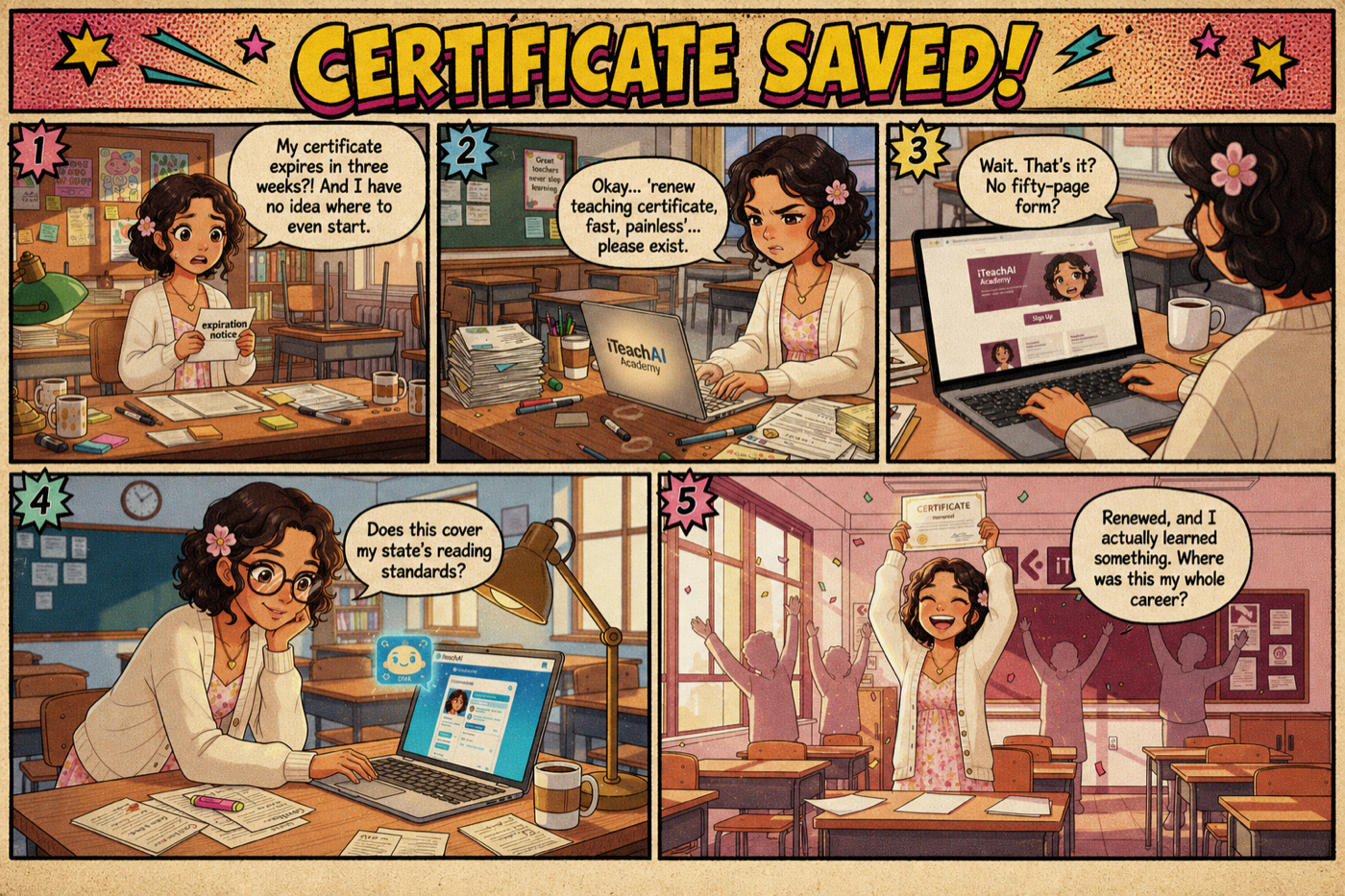
Renewal season, in five panels. Where was this our whole career?
Try This Week
Before you plan a single AI lesson for the fall, spend five minutes auditing what is already in your building. Open the tools your students actually use, a Chromebook, the Google or Microsoft apps your district licenses, and notice which AI features are already switched on, because Gemini and Copilot are increasingly built in by default. Then answer three questions. First, which assistant will my students reach for, and have I taught them to check its answers against a real source? Second, what does this tool do with student data, and can I name the protection for minors? Third, who in my building can turn a feature off if we need to? You will not answer all three today. The one you cannot answer is exactly where to start.
Safe travels to everyone heading to ISTE in Orlando this week. Come say hello.
Until next time,
Dr. Janette Camacho
CEO, iTeachAI Academy
P.S. iTeachAI Academy offers state-aligned professional development that counts toward your recertification in all 50 states, spanning responsible AI integration alongside structured literacy, MTSS, SEL, and your state's mandated topics, each course with a built-in AI guide to help you turn it into classroom practice. See what counts in your state at classes.iteachai.co.